


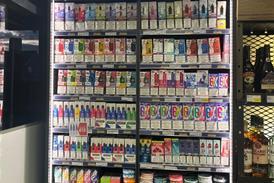

















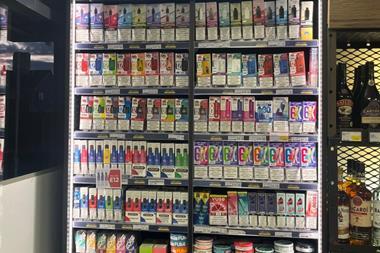
Plans to introduce a display ban and plain packaging for the vape category have raised concerns from both the retail and vape sectors.
Announced by the Department of Health and Social Care (DHSC), the proposed measures are subject to consultation, with a view to cracking down on youth access to the vape category.
Independent retailers expressed concern about the burden new regulations would pose for them.
Priyesh Vekaria of One Stop Carlton in Manchester, said: “I think it’s absolutely ludicrous. It’s regulation for the sake of regulation, and in my view it’s complete overkill.
“As a responsible retailer, I fully support robust measures to prevent youth access to vaping products. We already operate under strict age verification policies and take those responsibilities incredibly seriously.
“The new vaping licensing proposals are already placing significant additional obligations on responsible retailers. There remains a lack of clarity around how the new regime will operate, creating uncertainty and turbulence for legitimate businesses that are simply trying to comply with the law.
Priyesh added that the measures proposed won’t make a difference. “My concern is that further measures such as plain packaging and display bans won’t tackle the real problem. Instead, they’ll undermine responsible retailers while driving more consumers towards the illicit market. That takes legitimate trade out of the regulated economy and puts it into the hands of organised crime, rogue traders and criminal networks that have no regard for age restrictions, product safety or compliance.
“At a time when the Government says it wants to revitalise our high streets, policies like this risk achieving the opposite. Many responsible convenience stores operate at the heart of local communities, and we should not be penalised for the actions of a minority of illicit traders. Responsible retailers and petrol forecourts alike are part of the solution, not the problem.
“If the Government is serious about protecting young people, the focus should be on stronger enforcement against illegal traders, not imposing ever more restrictions on businesses that are already doing the right thing.”
Pontefract retailer Bobby Singh said retailers shouldn’t have any unnecessary burdens, especially if they’re being responsible.
“I think the absolute priority has to be protecting children and preventing young people from accessing vaping products. As retailers, we have a responsibility to play our part and ensure these products are sold responsibly, with robust age verification and compliance checks in place.
“Any new measures need to be practical and enforceable, with the focus on stopping illegal sales and those who don’t follow the rules, rather than placing unnecessary burdens on responsible retailers who are already doing the right thing.
“The key is getting the balance right protecting children while ensuring the measures introduced are effective and workable for responsible retailers.”
Association of Convenience Stores chief executive Ed Woodall warned of the costs for retailers. “A complete ban on vape and nicotine product displays in shops will be costly and complex for retailers to implement in the limited space they have available behind the till point, and we question whether a display ban is necessary alongside proposed packaging restrictions.
“We need to ensure any new vaping regulations strike the right balance between preventing youth access while still ensuring that vaping products are accessible to adult customers. We will work with the government to ensure these new measures are workable for retailers.”
In the vape sector, there was major concern about the proposals. Gillian Golden, IBVTA CEO, warned they could undo any progress made on reducing smoking.
“There is a real danger that ‘regulatory overkill’ will hamper the future of vaping as the UK’s leading quit aid for adults.
“If vapes were banned from display in the same way as tobacco products, this risks the Government’s goal of the UK becoming smoke-free by 2030 and could potentially kill off the responsible dedicated vape shops already struggling to compete with the illicit trade.
“Even worse, these proposals may contribute to continued misperceptions about the harm of vaping relative to tobacco smoking. New ASH data has found that only 6% of GB adults can accurately reflect that vaping is a lot less harmful than smoking. It is difficult to see how these proposals would counter those misperceptions.”
John Dunne, Director General of the UK Vaping Industry Association, said:
“Vaping has been one of the great public health success stories of the past ten years. It has become the country’s most popular quitting aid, is one of the most effective ways for adults to stop smoking and has helped millions of people leave cigarettes behind.
“Yet this extraordinary success is almost entirely ignored by proposals that would force vapes into plain packaging, strip products of the information adult smokers use to make choices and hide them from view as though they present the same risk as tobacco.
“The government’s suggestion that bright colours are a principal cause of youth vaping is not supported by its own evidence base. Among current youth vapers surveyed by ASH, only 4.9% said what a vape looks like was the most important consideration when choosing which product to use. By comparison, 42% cited what it tastes like. Packaging may have some influence on appeal, but the evidence simply does not establish bright colours as the main driver of youth uptake.
“We fully support firm action to prevent children accessing vaping products. Those who sell to children, market deliberately to children or supply illegal products should face meaningful penalties and enforcement with real teeth.
“That is why the UKVIA wants to see a vape retail licensing scheme which would allow vapes to be sold wherever cigarettes are sold, but prevent nail bars, fast food outlets and barber shops from doing so. Licensing could also fund Trading Standards to the tune of £50m per year to allow enforcement teams to clamp down hard on those who sell to children.”
Dunne warned that the measures could cause consumers to believe that vapes were on a par with cigarettes in terms of risk to health.
“Treating vapes like cigarettes at the point of sale will also reinforce one of the most dangerous misconceptions in public health. ASH has shown, year after year, that growing numbers of smokers wrongly believe vaping is as harmful as, or more harmful than, smoking.
“The government now proposes to take two fundamentally different products, place them under similar packaging and display restrictions and then expect smokers to understand that one is far less harmful than the other. That makes no sense whatsoever.
“Plain packaging and display bans will hand an enormous commercial advantage to the illicit market. Illegal traders do not comply with packaging rules, product standards, flavour restrictions or age-verification requirements. Ministers risk strangling the regulated market while allowing criminals to flourish.”
Eve Peters, director of government affairs for ELFBAR in the UK, urged caution when introducing new measures.
“The Government must carefully consider the evidence before introducing restrictions on vape packaging and display, ensuring measures protect children without undermining the role of vaping in helping adult smokers quit.
“We advocate for a more robust approach to vape retailing alongside an enhanced regulatory framework, including restrictions on packaging such as an end to the use of inappropriate imagery and flavour descriptors.
“Vaping products differ from tobacco and should not be concealed behind shutters. Displays should be responsibly positioned behind the counter, ensuring age verification to prevent youth access while remaining visible to adult smokers to support cessation.
“Protecting children is vital, but so too is not inadvertently confusing adult smokers with packaging and display restrictions that equate vaping with tobacco. The latest ASH data shows that 61% of smokers mistakenly believe that vapes are as or more harmful than cigarettes. This underlines the importance of striking the right balance to reduce youth appeal while avoiding measures that reinforce misperceptions about vaping, discourage smokers from switching and undermine progress towards a smokefree UK.”
Meanwhile, Haypp welcomed the announcement. Dr Marina Murphy, Head of External Affairs UK and Scientific Affairs at Haypp Group, said:
“Packaging regulations should reflect the different risk profiles of nicotine products. A one-size-fits-all approach that treats reduced-risk, smoke-free products in the same way as cigarettes risks making it harder for adult smokers to identify and switch to better alternatives.
Packaging has an important role in helping adult consumers distinguish between products, nicotine strengths and brands. Responsible businesses also need to be able to differentiate their products within the law, while ensuring packaging is not designed to appeal to young people.
The most effective way to prevent youth access is through robust age-verification, enforcement of existing laws and action against illicit sales. Packaging should support informed adult choice without undermining these measures or reducing the ability of smokers to identify less harmful alternatives.”











No comments yet