



















New research covering information from 39 retail giants across Europe has identified the most promising interventions to improve the shopper journey and reduce loss.
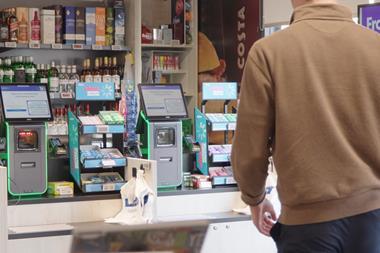
Self-checkout (SCO) has become the customer’s preferred way to pay, new research from researchers ECR Retail Loss shows.
In stores where it’s available, 54% of transactions taking place in the retailers that shared data now go through SCO.
The most comprehensive study of its kind to date outlines how retailers can build on that adoption while tackling the loss that can comeswith it.
The study, by Professor Matt Hopkins of the University of Leicester, commissioned by ECR Retail Loss, draws on data from millions of individual self-checkout transactions.
Its sample finds that self-checkout generates loss, with shrink rising 22% on average in the first year after its introduction. But total losses are no higher today than in 2018, showing the industry is learning how to manage SCO better.
Non-scan loss at SCO happens along a spectrum from “theft to honest mistakes with awkward items, unfamiliar menus or fiddly barcodes,” ECR said. Customers are also often frustrated when items won’t read or staff are slow to help.
The industry struggles to differentiate stealing from a slip-up at SCO, with retailers’ own estimates of how much SCO non-scan is malicious varying widely, from 6% to 80% of losses being attributed to theft.
The study advocates for prevention efforts that tackle both, while prioritising interventions that reduce non-intentional missed scans caused by design failures.
So-called ‘nudges’ on screens signal to the customer the system is paying attention. The most effective example are prompts that ask shoppers to check or rescan items. Customers self-correct in more than 80% of cases, once this nudge happens.
Missed scans are the most frequent loss type, occurring in 1% to 4.8% of SCO transactions.
Walkaways are far rarer, but they happen when a customer triggers payment, it fails to go through, but they still leave with the goods. As contactless payment limits rise, walkaways are a growing concern, and most existing non-scan detection technology is not built to catch them.
So it seems retailers face a live challenge as shoppers adapt to the technology. Several see this as the next-generation challenge for SCO, with some predicting customer behaviour will change.

It could trigger higher incidents of shoppers switching bar codes, stacking multiple products to shield them from the technology or finding innovative ways to make payments fail.
Colin Peacock (left), group strategic coordinator at ECR Retail Loss, said: “Most SCO loss is generated by ordinary people making everyday mistakes. That’s good news. It means retailers can engineer their way out of the problem. This report shows them what works, and how well.”



![GA-2916[73][63][94][66][68][68][58][37]](https://d2dyh47stel7w4.cloudfront.net/Pictures/380x253/0/5/8/398058_ga29167363946668685837_326681.jpg)





1 Readers' comment