

















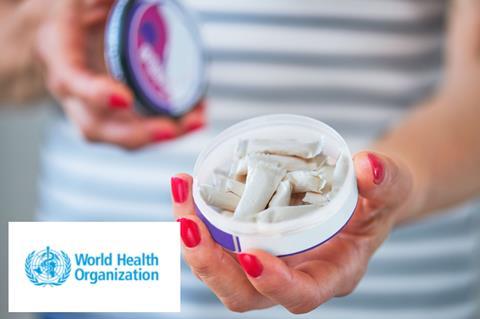
The World Health Organisation (WHO) has just issued a report that has now been described by campaigners as “attacking” nicotine pouches.
Nicotine reduction groups say the report ignores the key evidence on reduced-risk nicotine products, saying its information is made up of “dangerous misinformation that could cost lives.”
They add that the document ”repeatedly blurs the distinction between deadly combustible cigarettes and dramatically less harmful smoke-free products” - despite growing evidence that nicotine pouches sit at the very bottom of the risk spectrum.
The WHO warns that harm reduction tools - already used by Sweden to become the only smoke free country in Europe - are “aggressively marketed and promoted to young people,” and claims they’re helping “normalise nicotine use.”
However, campaigners said the report is remarkable for what it leaves out - that cigarettes kill up to half of long-term users, while nicotine pouches contain no combustion and no tobacco leaf, the primary drivers of smoking-related cancer, cardiovascular and lung disease.

Richard Crosby (left), director of Considerate Pouchers UK, said: “The WHO appears unable or unwilling to communicate relative risk. That matters, because when public health bodies imply all nicotine products are equally dangerous, many smokers simply continue smoking - which is by far the worst outcome.
“The report itself acknowledges that nicotine pouches don’t contain tobacco leaf, but attacks the idea they can be marketed as a replacement for cigarettes - despite them being used by smokers trying to quit. This is a dangerous, illogical position.”
“This report forms part of a broad, aggressive, anti-nicotine ideology.”
The report further attacks slogans such as “no smoke, no smell, no hassle.” Crosby added: “Those statements are objectively true. Nicotine pouches don’t produce smoke or smell, and pretending otherwise is scientifically absurd. This report is not evidence-based public health - it forms part of a broad, aggressive, anti-nicotine ideology.”
The WHO also warns that nicotine pouches are marketed for “discreet” use and claims this “undermines regulations prohibiting smoking.” But campaigners said using a smoke-free nicotine product discreetly is not remotely equivalent to smoking cigarettes indoors.
The WHO also claims nicotine pouches are marketed with “unsubstantiated claims” relating to smoking cessation. Yet real-world evidence increasingly shows smoke-free nicotine products are replacing cigarettes for millions of adults campaigners said.
Mark Oates, founder of We Vape, added: “The Swedish experience completely undermines the WHO’s narrative. It achieved historically low smoking rates not through prohibitionist ideology, but by giving smokers acceptable alternatives. To ignore this raises serious questions about the credibility of WHO and its motives.”

The WHO report expresses alarm at the rapid growth of nicotine pouches, noting global sales rose by more than 50% in a year and that the international market is now worth nearly £5.6bn.
The organisation additionally criticises nicotine pouch companies for sponsorships, influencer marketing and youth-oriented branding. Campaigners agreed youth marketing restrictions should be strictly enforced, but accused the WHO of using those concerns to justify “demonising” nicotine itself.
The WHO paper follows the granting of Royal Assent of the Tobacco & Vapes Act, which has age restricted pouch sales to 18+. While calls for strength caps were ignored, they remain an option. The 20isPlenty campaign, led by Considerate Pouchers UK, establishes a 20mg per pouch limit as the definitive ‘Goldilocks’ standard for nicotine regulation – a safe level but strong enough to stop a heavy smoker lighting up.
The WHO report can be read in full here.










No comments yet